

Well well well, since announcing that I was going to be covering the Cormoran Strike series by JK Rowling, I’ve lost about 100 subscribers and a not insignificant amount of paying subscribers.
Now, some of this is just the normal churn of subscribers. There are a thousand reasons why someone might unsubscribe or stop paying for a subscription, but I suspect it’s related to writing about JK Rowling.
When I wrote about the Harry Potter series, every new review led to a flood of unsubscribes. I persisted in writing about Harry Potter against any kind of business sense because, well, I wanted to.

I did expect this. It’s why I took note of how many subscribers I had before I published that piece in order to compare it to how many are left right now.
You don’t have to believe me when I say this but I really do not look at the numbers on here. There was a time when that was not true, where I kept track of subscriber growth and views and things like that, which is why I knew exactly how many people were leaving when I wrote a new review of Harry Potter. But for the last two years or so, I just stopped looking. It’s why I stopped putting prompts to share and subscribe in my posts. What does it matter if this review you’re reading is read by 300 people or 30,000 people? What does it matter if this costs me another 100 subscribers or gains me 1,000?
I suppose if it mattered more to me I wouldn’t be doing this at all because it’s so obviously a bad business decision and maybe even bad for my career as a writer. But again, who cares?
You’re either here or you’re not. I’ll be writing it anyway.
If you’d like to catch up on the series:
Now let’s get on with it.
What’s in a Name?
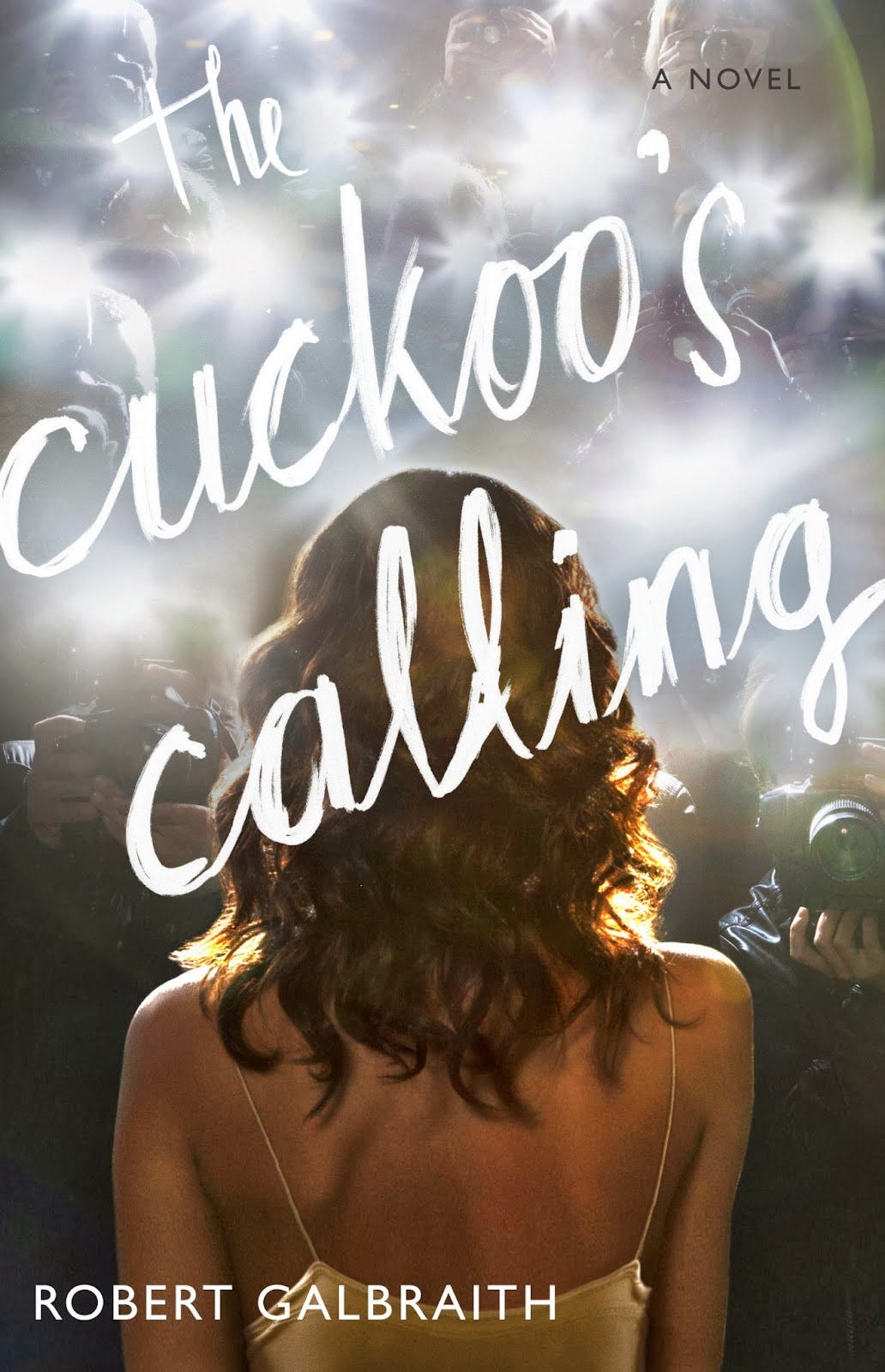
Before we dive into the novel, I think it’s worth discussing why this is a Robert Galbraith novel and not a JK Rowling novel.
After Harry Potter, Rowling put out an adult realist novel called A Casual Vacancy. The novel wasn’t very well received but it was successful, no doubt, because of the author attached to it. Perhaps out of curiosity or frustration, Rowling picked up a pseudonym—a male pseudonym—and wrote a detective novel.
She was revealed as the author relatively quickly. You can read a bit about how it happened here.
She described writing pseudonymously as liberating, which makes sense, considering she was and remains the most famous writer on the planet. And I think we may as well take her word for it.
It’s not like she needed the financial success of these books. But I imagine part of the impetus behind this name change was to see if she could do it again. Could she become a bestseller without the weight of her name on the cover? Would her new books be successful dropped into the world as if by a debut author?
Sadly, we’ll never know.
I mean, it sold all right out the gate! Not well for a Rowling novel, but certainly pretty well for a debut mystery writer. But once Rowling was revealed as the author, this catapulted in popularity and justified all the subsequent sequels.
Disasters Hound Him
We’re introduced first to Robin Ellacott. Young. Pretty. Newly engaged. She’s walking to her first day as a temp at a detective agency. What could be more exciting! Sure, she’ll be a secretary and not, you know, a detective. But still!
When she arrives, the first thing that happens is a beautiful woman storms out and past her. A moment later, a very large man rips the door open and nearly knocks Robin over. She stumbles back and is about to fall down the stairs but this large man reaches out to save her and inadvertently grabs her tightly by the breast. Awkward, humiliating, but it saves her from falling backwards down the stairs.
This is our introduction to Cormoran Strike and this series, and I think it’s worth stopping right here to examine, for a moment, what this foreshadows.
We don’t begin with the case or the mystery. Instead, we begin with these two very different people. Rather than a femme fatale walking in through the door to send the detective on towards the case that will drive the novel, we have the beautiful dark haired woman rushing away from our detective. And though he chases after, he runs face first into a woman who will define much of his future, into the relationship that will drive this novel and series onward, into a woman who gives everything to make him a success.
And in the immediate short term, rather than a femme fatale, she just wants her new boss to think well of her. Possibly even to like her as a person. There’s no calculation in her. No scheming to take down this man or any other. She’s a bit of Hermione. Clever, perky, and desperate to please, which may very well be her greatest weakness.
And this is where we start. With people. With relationship. Not with grisly crime and some new case for our detective to work. An archetypal bad girl walking out on Strike and an archetypal good girl walking in on Strike’s life.
But let us meet Strike.
The one-legged bastard son of Jonny Rokeby, a famous rockstar, Cormoran is gruff and short tempered and generally unfriendly and miserably, horribly broke.
So broke that he had canceled the temp agency’s placement, though no one passed this information on to Robin. So now she’s here with this large, unfriendly man who doesn’t want her there when John Bristow enters wanting Strike to investigate the suicide of his adopted supermodel sister, Lula Landry.
Bristow is sort of an acquaintance of Strike. His elder brother, Charlie, was one of Strike’s childhood friends, though Charlie died tragically when he was about ten years old. This tragedy led the Bristows to adopt Lula.
The Bristows are very wealthy, it’s worth stating, and so when John offers to pay Strike to investigate his sister’s suicide while he’s facing eviction, he can’t help but agree, even though, morally, he believes he should not take the case.
After all, it seems an open and shut case that Lula killed herself by leaping from her balcony—which is why the police deemed it a suicide a few months earlier, when she died.
Why We’re Really Here
Bristow leaves and we return to Strike’s life outside the work. The woman who left his office earlier is Charlotte Campbell, his on again off again girlfriend/fiancée of the last sixteen years. She’s a wealthy socialite and Strike was her live-in boyfriend/fiancée ever since having his leg blown off in Afghanistan. Now that they’re broken up and he’s penniless, he comes to realize that his office is his home. And Robin does her best to not let Strike know that she knows that he’s sleeping on a cot in his office.
Strike and Robin are in a bit of limbo. Thanks to the Bristow case, Strike can now pay Robin but not for long. She’s pleasant and accommodating and clever and he’s just a man in the midst of a sequence of the worst days of his life.
It’s a brilliant set up, honestly.
We won’t go into the nitty gritty of the case or all the detective work that gets us there, because, for me, this isn’t really what hooks me, what keeps me going. Like I said, I’m not really a mystery reader. Never have been. I’ve read, I would bet, fewer than fifty mysteries in my life. In adulthood, I’ve probably read twenty, with the vast majority of those happening this year (remember, this series is itself eight books). People being cops and doing detective work just doesn’t do a lot for me.
The strength of this novel comes from the ways Rowling stacks tensions.
Robin’s fiancé, Matthew Cunliffe, is an accountant moving up in the world. He and Robin have been together for years and he does not approve of Strike, nor does he approve of Robin working there. But he’s a nice guy, yeah?
He’s nice.
Anyway, he wants her to move onto a better paying job at a company that doesn’t seem about to collapse, which is pretty good advice, by any metric. But Robin is finding she likes the work. More than that, she’s able to help Strike, and Strike is willing to accept and take her help.
She’s quite clever, after all. Has a bit of a knack for this detective business.
So we have a tension between Robin and her fiancé as one lever. Another is financial. Another is the difficulty of the case. Another is a growing tension between Strike (not a cop) and the police (the cops) he knows and whose help he needs. Still another is between Strike and his half-sister Lucy, who just wants Strike to be happy. And, finally, the tension between Robin and Strike, which begins here and carries us through the next 6,000 pages.
Their tension is multifaceted. For one, Strike is immediately attracted to Robin. For another, Robin is inexperienced. For still another, he can’t pay her. For yet another, she wants to work there. She wants to help, even if the pay sucks and the hours are long.
She wants this.
The Case and all that
There are a few things hanging over this novel that make it all so difficult. We’ll go through them in turn.
Money - Strike ain’t got none of it, and this makes everything rather precarious. Every time Strike takes a cab, he’s counting the blocks, counting the pennies.
One leg - Strike, as I mentioned, only has one leg, and he’s not been taking care of it or himself to the degree that he needs to. Adding to his problem is a bit of vanity. He could use crutches or a cane, but he prefers to hobble along on his prosthetic, even when it causes him great pain. Which it often does because he’s about twenty or thirty pounds overweight (my wife told me something interesting - every extra pound you’re carrying is like adding four extra pounds to your knees).
Jonny Rokeby - Strike’s rockstar father, who does not appear in the novel, but whose fame and notoriety cast a far shadow. More than that, Strike took a loan from him to start the business. This galls Strike and he’s desperate to pay him back and clear himself of the debt, which also leads us back to point 1. He tries his very best to have no contact with Rokeby for reasons that are both complicated and not so complicated.
Charlotte Campbell - Strike’s longtime lover haunts nearly every page of this book despite only appearing in that brief moment at the start.
Class - Class is all over this novel and the series more broadly. Matthew is a middle class striver. Strike is a low class brute who can quote ancient Greek poetry. Charlotte is a rich girl and the Bristows are all rich kids. Strike swims with fishes made of money while he himself is so broke that he can barely afford to buy himself lunch.
The Cops - The London police are not thrilled that Strike is investigating an investigation that they ended. They deemed her death a suicide and there’s no reason to believe otherwise. But Strike also relies on his many contacts in the police force to pass him information. It’s a complicated situation, but Roy Carver is one man who seems to despise Strike.
And so we go on and get red herringed and find leads and come to the thrilling conclusion that is, to be completely honest, sort of hard to follow and maybe harder to believe, but it all makes enough sense. It’s just a circuitous route and I’m maybe dumber than the average mystery reader, but Strike solves the case!
He proves the police wrong, which is bad news, in the long term, for his relationship with the cops, but it does wonders for his agency’s prospects. After all, this becomes a very high profile case due to Lula’s fame. Add to that proving that the dang cops blew the case and that the man who solved the case is the bastard son of a famous rockstar and you have a bit of a media frenzy brewing.
Oh, and it is very important to know that at the end of the novel, as a goodbye gift to Robin, Strike buys her a fancy dress that she tried on during the investigation. His attraction for her has grown to the point where he can’t ignore it, but, at this point, he fully expects to never see her again.
She’s engaged to another man, leaving for a new job, and is over a decade younger than him. The chances of them running into one another is unlikely, and so he feels it’ll be okay to give her a gift that could easily be construed as romantic in nature.
Of course, the little sticking point is that she chooses to keep working for him, even though Strike can barely afford to pay her.
This is the perfect engine for narratives to spiral off of.
The Rowling of it all
We can see a line from Harry Potter to Cormoran Strike, as I discussed in the Introduction. But what we really see here is Rowling at the top of her game.
All the praise she received for making wonderful and distinct characters throughout Harry Potter is brought to another level here. Strike’s London is populated by weirdos and freaks but also kind, goodhearted people. People with their own motivations and internal tensions.
In Lucy, we see a bit of Molly Weasley. In Robin, a bit of Hermione. In Strike, a bit of Mad-Eye Moody, though tempered by Remus Lupin and with just enough dash of Harry Potter, if only by their similar circumstances.
Both Strike and Harry are haunted by their parents, by the fame thrust upon them, by the damage done to them. Harry cannot hide his lightning scar just as Strike cannot outpace his missing leg.
And the London she builds is not exactly thick as concrete, but it does feel substantial enough. There’s a texture to the place as she builds it. It’s not the whimsy of Harry Potter but it’s every bit as grounded and comprehensible and lived in as Hogwarts. Though how lived in does Hogwarts feel is a more complex question than you may think, at least at first.
But everything that Rowling did well in Harry Potter is improved here in Strike. The writing is simply better. Her command of action and mystery and character is stronger. There’s an effortlessness to this whole endeavor, and you feel that in the prose, in the structure.
For all the ways I may fault Rowling as a writer, she has always been propulsively readable. And these are some of the most readable books I’ve ever encountered.
I mean, it is rare for me to read a series from start to finish without taking a break for another book, but I just blasted my way through all eight, barely taking a breath to look at another book, to even think about picking up anything else.
A New Beginning
Look, I’m not interested in or invested in making you like Rowling or even her books. But if you have ever trusted my opinions here on art and specifically literature, I’m telling you that this book is at least worth a glance.
If you don’t like it, well, that’s fine. People don’t all like the same things.
But if you dig it, if you couldn’t put it down, then you’re going to enjoy this wild ride that we’re off to together.
So buckle up, because we’ve miles to go this year through Rowling’s London.
I love a good mystery, but I agree that isn’t really the main attraction in these books.
And yeah, class in both its traditional and modern forms is a HUGE thread in these books. And the first one does a great job, I think, of pointing out what’s funny about class relations without ever devolving into broad parody. People remain people, even though they’re recognizable class “types,” too.
I've been meaning to read these books for ages. Maybe this is a sign to finally start them!