

An Itch
Call it morbid curiosity or some compulsion towards being coated in grime and dirt that I learned from my dear sweet long dead dog, but something’s been brewing in me. I sometimes get these urges to read books that I had never previously been interested in.
But perhaps my dad trying his best to die prepared me well to dive into some doomed literary project.
Two years ago, similar compulsions led me to reread Harry Potter for the first time.

Curiously, this was taken as a political act by some. With each review, people would unsubscribe by the bucketful and yet I pressed on against any kind of business or reputational reason. I had someone accuse me of engaging in genocide, which is quite an accusation. I cannot say that I was completely surprised, but I did find it somewhat annoying that culture had moved in such a way that we cannot talk about books as books, but must talk about them as badges of morality, of honor. And by simply engaging with certain books—some of the most popular books ever written—you are aiding and abetting some sort of political project.
And, I mean, not for nothing, I think it would be hard to read my reviews of Harry Potter and come to the conclusion that I like or approve of some kind of political messaging happening within them.
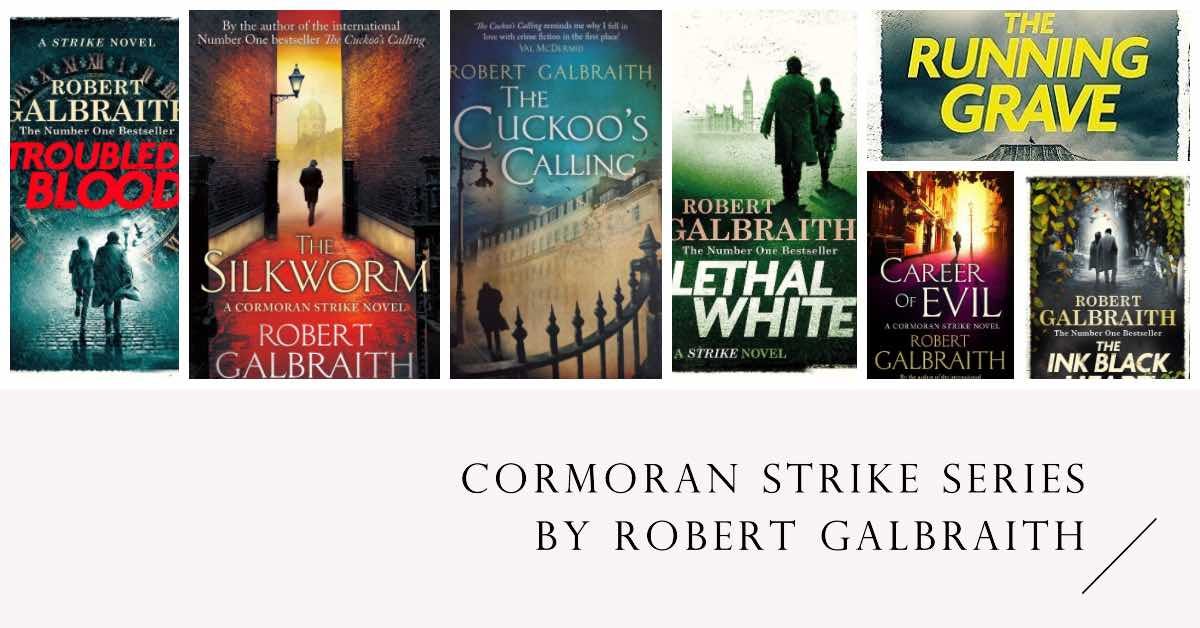
Yet there I was sitting in my family room while our kitchen remodel dragged on, with my family forced to essentially live in one room in the house, thinking to myself, I wonder if those Cormoran Strike novels are any good.
Give it a Scratch, fella
Well, I took a look at my library and they had the first four available. Just sitting there, waiting for this exact kind of curiosity to strike me at just such a moment when I could roll over and feast on a literary project while my life sways in a strange state of stasis but also constant flux, the ground perpetually unstable beneath my feet, the world sloshing all round me while my father does his best dying man’s dance, while our house is in an absolute state of disrepair before it’s reconstructed, while we try to sell my parents’ house to deal with some disastrous financial decisions my father made that may cause me to sink along with him unless I can cobble things together rapidly.
Thus and so, I cracked open the first book. After about a day and a half, I cracked open the next and then the next and then the next. Then I got the fifth and sixth books from the library, and after about a month from when I started, I had read all eight of these novels. With a ballooning page count per book, I read roughly 6,000 pages of good ol fashioned detective fiction over those brief yet endless September weeks.
Which is a genre I have a troubled relationship. Or rather, it’s cleaner to say that I generally don’t much care for detective fiction or even mysteries more broadly.
Those who have known me since my neo-noir days probably felt their jaws hit the floor, but I do consider noir, and especially neo-noir, considerably different from mysteries. Maybe that’s all quite superficial or hairsplitting to you, but this is my little corner of the internet where I get to be lord and master.
For reasons that I’ll explain at length over the eight coming reviews, I’ll get to why these novels worked so well for me where dozens of other mystery novels have not.
One simple reason that’s worth saying up front is that JK Rowling has improved as a writer. This is a rarer accomplishment than it should be, but Rowling has become a writer who I think is truly worth reading.
Which is difficult for many people who live online to handle. And so I suppose I must discuss Rowling herself a bit.
The Author as Enemy of the People
This is something I’ve discussed a few times, but you can find the most succinct example here, I think:
torture the audience who loves the artist

The definitive biography of Dostoevsky was written by a Jewish man. It's, I believe, four or five volumes.
Though you may also want to look here:
guilty by association

I’m e rathke, the author of a number of books. Learn more about what you signed up for here. Go here to manage your email notifications.
Both of these essays are largely about engaging with art by people we find reprehensible (or, in the latter, engaging with art by someone who merely likes someone who you find reprehensible), so I won’t rehash everything here.
Now, I prefer to stick closely to the text and discuss a story based on the words on the page rather than what surrounds them beyond the text. My short story podcast is dedicated to this, for example. We analyze the text, rather than analyzing the author or the sociopolitical and cultural context of the work.
And so I’d like to be able to discuss JK Rowling in this way, since I do genuinely find her a fascinating author. I think her career as a writer is one of the more interesting careers to look at. However, this is trickier to do with Rowling, in part because her novels interact with her critics. We saw this with her depictions of fame and journalism in the Harry Potter series. We also saw how she purposefully drew real life parallels between her wizarding world—like the house elves—and real world political topics, like slavery.
This invites us to pull Rowling herself into the discussion of the text. And we’ll have to do that in several of the Cormoran Strike novels.
And this is part of what makes her fascinating to me. As does the fact that so many people have turned against her due to her public statements about trans people. It is genuinely interesting that such a beloved author, someone whose liberalism so deeply informed her work and even her public persona, has become one of the greatest enemies of liberals on Twitter and Bluesky. Interestingly, this has happened as she becomes a more interesting author.
And perhaps this is a strange perversion of mine, where I find controversial artists interesting and worth discussing. I find it fascinating that Knut Hamsun and Louis Ferdinand-Celine wrote some of the most interesting novels of the 20th Century and then went on to be Nazi propogandists. I find Kanye West’s turn towards extremism fascinating. And the list goes on, whether it’s Michael Jackson, the pedophile, or Roman Polanski, infamous rapist. I’m drawn to this tension, this conflict between the work and the person. Drawn, perhaps, to extreme behaviors, to extreme ideologies, the same way some are drawn to watch trains or shipwrecks.
To put it simply, this fascinates me. I cannot look away, cannot help but scratch at it.
At the same time, I think it’s worthwhile for many people to consider how Rowling’s controversies largely only dog her on Twitter and Bluesky. I wrote a bit about this last year:
of Rowling and Cormac and what it means to cancel

Last year, I reviewed each of the Harry Potter books. I’m very lazily turning these into a book by adding reviews to the movies. I may also add the Fantastic Beasts movies because why not. Let it become a book about all the Wizarding World.
And that piece was not unrelated to this previous piece here about the Hogwarts game and the media blacklisting of it, despite it going on to make a billion dollars or some such number.
Videogame criticism needs to grow up

Happy Valentine’s Day. I don’t have anything especially romantic to write for today, but you can check out this post from last year.
What these two pieces get at is that the attempts to cancel Rowling have failed utterly. Bookstores will continue to carry Harry Potter, possibly until long past our great grandchildren are dead, and her movies will remain a yearly ritual for many families.
It’s worth noting, too, that her Cormoran Strike novels have sold over 20 million copies by themselves! That’s a drop in the bucket compared to the 600 million copies of Harry Potter, but it also makes them some of the more successful books of the last decade. So to say that her political views have materially harmed her is, honestly, absurd.
And perhaps you could say that the drop from 600 million to 20 million is purely because of politics, but I think the simpler answer is that most writers have one work that outsells all the rest by a sizeable margin. Sometimes this happens late in a writer’s career, like George RR Martin, but sometimes it’s at the start, with everything else lagging well behind.
For people who spend too much time online, Rowling may feel well and truly canceled, but you might be surprised just how many people have never even heard of the controversies you hate her for. More than that, it may come as an unpleasant surprise to learn that most people, at least in the anglophone world, agree with her views on trans people.
Now, if you showed them her Twitter page where she posts about trans people dozens of times per day and rarely posts about anything else, they might feel differently about her specific attitude towards trans people. If nothing else, they might consider this fixation unpalatable, especially for a beloved—or once beloved—children’s author.
So this is who JK Rowling has become to people who use sites like Twitter and Bluesky. It’s also who she has turned herself into online.
Can you deal with that?
Perhaps not!
Perhaps you cannot appreciate books written by someone you find unpleasant or vile.
That’s all up to you.
And so perhaps you’ve no interest in the coming essays about Cormoran Strike and would prefer to never hear about Rowling ever again.
I won’t blame you. We all must decide what to do with the precious minutes of this life. For me, that often means chasing strange obsessions.
But if you’re still reading, I’m going to briefly make an argument for why you should give these novels a shot.
Continuing Hogwarts
It may be surprising to many people who know Rowling for Harry Potter that she went on to write a series following a private detective who solves grisly murders that sometimes involve sexual violence. What would make a beloved children’s author shift her career so dramatically?
Well, the simple fact is that she didn’t. In fact, Cormoran Strike is almost a perfect continuation of Harry Potter.
I mean, in some ways, that’s obviously not true. There’s no magic school. There’s no magic at all! But in almost every other way, this feels like the plain and obvious next step after writing Harry Potter.
Each Harry Potter novel is structured more like a mystery than it is like a fantasy novel. Oh, sure, there’s all the magic to contend with, but each of those novels is more or less a detective novel where the detective is a student at a school. She’s not the first to do this, mind. The Boxcar Children, the Hardy Boys, Nancy Drew, et cetera, et cetera, etc.
In fact, her Harry Potter novels often struggled most when she deviates from the mystery structure.
JK Rowling was always writing mysteries, was always writing detective fiction.
Along with that, the unique aspect to Harry Potter is how it aged up with its audience. If you were ten years old when Harry Potter and the Sorcerer’s Stone came out, you were twenty when The Deathly Hallows came out. You likely would not have been too invested in the series as you grew up had the content of the books not aged up with you.
She didn’t have to do this. The books could have remained books for ten year olds, even as Harry Potter got older, but she chose to have the content and storylines grow darker and more complicated as her core audience grew up.
Well, if you were ten years old in 1997 when the first Harry Potter came out and were twenty years old when the final one came out, you would have been 26 when the first Cormoran Strike novel came out and you’d be 38 right now, when the eighth Cormoran Strike novel came out.
You’re ready for your favorite author to continue writing for you at the age you are. And Rowling is still doing that. Still following those kids who picked up Harry Potter when they were eight or twelve, and she’s been growing with them, feeding them new books appropriate to their age as they hobble on towards middle age.
This is interesting.
If you don’t find this interesting, I just don’t know what else to say to you about it.
Now, we’re eight books into Cormoran Strike and Rowling promises the conclusion will be at ten books. We’re also twelve years into Cormoran Strike, which means she’s been writing this series already longer than she wrote the Harry Potter series. The volume of time she’s spent with these characters and the sheer volume of words demonstrate, to me at least, how she weighs these two series against one another.
And I do think that these novels are legitimately good. Not just good for mysteries or good as a follow up to The Deathly Hallows, but, like, actually good novels. More than that, I think Rowling has become a far more accomplished writer with each book (though I’ll have lots to say about this once we get to The Hallmarked Man).
We also see a much clearer political focus. Much of this is because she doesn’t chase a storyline as poorly thought out as the house elves again. But a much bigger piece of this is that there’s a real clarity to this series.
If I could sum it up in a single sentence, I would say that the Cormoran Strike series is obsessed with the ways society contains, constrains, and brutalizes women.
Yes, it sometimes dabbles beyond this and pokes around in other political fights or topics, but the main thrust of the series hinges around the threats to women, and the ways in which women must fight for even scraps of equality, even in this enlightened modern age of feminism and Good Men and Allyship.
What Now?
Well, if I’ve piqued your interest, I’m going to lead you through this series. What will the pace be? I cannot say right now. I should know, since all the posts will be written by the time this post comes out. I mean, I could just post it week after week, but I think I’ll post them monthly. That seems the right kind of cadence. It will also give those who want to read along with the series of essays time to read the novels.
So, yes, let us settle on a monthly schedule.
The Cuckoo’s Calling - January
The Silkworm - February
Career of Evil - March
Lethal White - April
Troubled Blood - May
The Ink Black Heart - June
The Running Grave - July
The Hallmarked Man - August
Addendum
I may also decide to watch the TV series adapting the books. If so, I’ll write about them as well. Maybe as a single post. We’ll see.
Also, I am curious to hear what you make of the compressed timeline of the books — the way she has chosen to let the world of the stories lag behind real life history, so that the most recent book only takes place around 2016, I believe. It’s a strange and clearly deliberate choice, and I haven’t decided yet what it means.
I think that’s a great summary of the running theme of the books, even though some of what I like most about them has nothing to do with the constraining of women (at least superficially). But that’s undoubtedly the deep wellspring that feeds the overall work.
(And while the books are nominally the “Cormoran Strike” series, and Strike is undoubtedly the hero and the moral center, there’s a strong case to be made that Robin, the long-suffering Chief O’Brien of this world, is really the main character.)
Really looking forward to this read-through.