

The Past Won’t Leave
My father used to speak German to me.
He sang German. He shouted German. He laughed in German and tried to make all of us laugh and sing and shout with him.
Such joy. Such fervor. He’d play oompah bands and sing and dance so loud and so boisterously that we could not help but laugh, but smile, but dance with him.
I never learned German.
When my brother and I were in middle school, he even hired a German tutor for us to connect us to that root of our ancestry, to his. She had horrible teeth and smelled terrible but she was patient and kind while my brother and I quietly never learned a single thing over several months of her arriving at our house once a week until my father gave up on the whole affair.
All that we could have been. All these opportunities handed to us like flowers and left scattered in the stones like wilted petals.
My father grew up about as poor as it was possible to grow up. In 1962, his father died a week after he turned eight. My grandmother had seven kids, no job, and didn’t know how to drive. She never learned to drive but instead rode the bus here and there, fighting the city and banks to buy her house where she raised my father and his brothers and sisters. She never remarried.
Her kids ran wild and my father barely graduated high school. He nearly died by contracting spinal meningitis when he was seventeen. He spent weeks in a coma. The doctors told his mother he would never recover, that if he survived at all he’d be a vegetable, still and inert as stone.
When he woke, he couldn’t read or write. His older sister taught him how again and he went to college a semester late while he recovered. A few years later, he had a masters in civil engineering. For the first time in his life, he wasn’t poor and he realized he never wanted to be again. And so he worked tirelessly to succeed. A few years later, he got married and started a family. He found his dream company, but they were based in Germany so he learned German to get the job and then spent 10 or so weeks a year in Germany.
My father’s family came to the US in two primary waves. First in the 1750s and then in the 1880s from Prussia. He has always identified with his Prussian ancestry. Not German, but Prussian. I think there’s a beauty in lost civilizations that many people share. There’s a mystique to being Prussian now that Prussia no longer exists, hasn’t existed for over a century, ever since a certain Kaiser lost a certain world war.
And so when my father learned German, when he spent years running a German company in the US, when he frequently got to travel to Germany and speak German, I think he felt, perhaps for the first time, like he was coming home, his fingers tracing bark and branch, the gnarled roots of his name, the source of his blood and bones.
I remember landing in Limerick. I remember those Irish skies and the impossible greens of the countryside. I remember that grey ocean and the way language rolled and burred.
I remember the Black Cab tours and the Garden of Remembrance and the way my blood burned cold and my heart turned to stone and my eyes stung over all the horrors visited upon my ancestors while they fought for freedom. I felt home there. Like the echo in my blood ringing out, passed to me by my grandmother and grandfather whose grandparents survived the deathboats filled with the skeletal, the destitute, the hopeless.
I saw the places my nameless ancestors came from. Heard the way my mother’s maiden name sounds in Irish, rather than the way we learned to say it here in America.
In Ireland, people spoke German to me at times. I took three semesters of German but still it never took root in me and the only thing I knew how to say was Ich verstehe nicht or nicht spreche Deutsch to which the speaker would usually say, I thought you were German. This happened more in Germany, where everyone thought I was a local, belonged there, and I felt a stirring in my own blood, for this place I never had much interest in but that had imprinted itself on my face, in my bones, in the color of my skin and hair and eyes.
I have the face of my father. Everyone who knew my father when he was young says so and I have seen the pictures. My second son has his face too and, perhaps, his temperament.
Blood and bone, root and stone.
I stood at the roots of the German Alps and high atop them and felt the awe of countless generations as I stared out into the widest skies I’d ever seen, where those long gone people believed in Wotan and Jotnar and I could not blame them, began to feel them myself.
A stirring in my blood rising through the stones of the earth. Old and ancient abandoned gods.
But though I have my father’s face, I have my mother’s heart, and though I have my father’s eyes, I see with my mother’s vision. And so I kept coming back to Ireland, kept feeling most at home there, and even now, all these years since last I stood upon my ancestor’s land, I still find myself returning to those months, to those endless nights, to days I hoped would never end, to the sorrow and pain and awe and beauty I found there. The way it changed me. Shaped me. Made me into the man I now am.
By a lonely prison wall, I heard a young man calling
"Nothing matters, Mary, when you're free
Against the famine and the crown,
I rebelled, they cut me down.
Now you must raise our child with dignity."
—The Fields of Athenry, Peter St John
Blood and bone, root and stone, all alone we always come home.
Days Before, Between
The first novel I ever read in translation was The Confessions of Felix Krug by Thomas Mann. Famously, this novel was unfinished when Mann died but it landed in our home because my older sister had been assigned it in her lit class in high school.
She never read it but I picked it up and unhinged my jaw and swallowed it whole.
It’s been probably 25 years since then. I was barely more than a child, coming off of Lord of the Rings and Speaker for the Dead, and though I was tinkering with Oliver Twist and Dracula too, The Confessions of Felix Krull was the first novel I’d encountered to describe ejaculate and use the word come that way. At this point, so many years later, I don’t remember much about the novel, but there was something illicit about it all. Not only was it quite literally not meant for me, since it belonged to my older sister, assigned for her class, but it was so clearly not meant for me because it was, perhaps, the first true adult novel I’d read in my life. As in, a novel written exclusively for adults to read.
I found it intoxicating in that way. Like every page was stolen. Like every hour I spent inside it was illegal, something to get me in trouble, to get books burned, if only my father knew. Because he was not above such things, as I described in this old essay:

Reading had already opened the world wide for me, but in Mann’s unfinished novel, I found a vastness before me and beneath me. All around me. It showed me other worlds. Not fantastical or science fictional but here, beside me, near at hand, just a fingertip away.
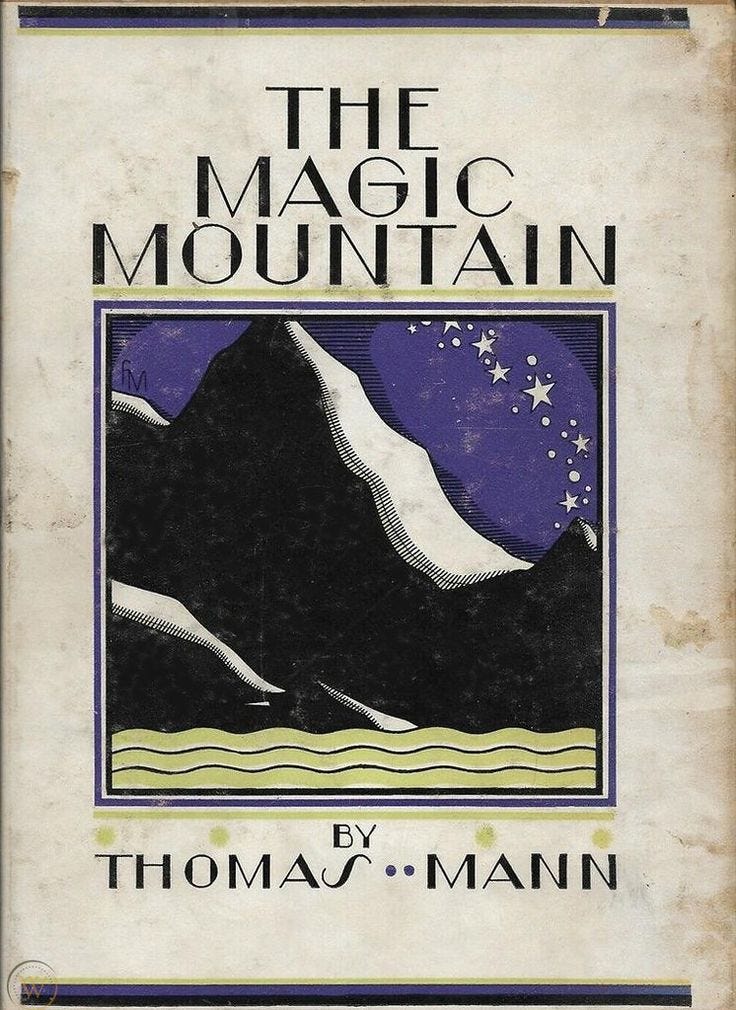
I picked up Death in Venice many years later while I flew to Ireland for the first time. In truth, I remember almost nothing about that novella, but I began buying Thomas Mann novels, though I would not finally read one again until a few weeks ago when, for no good reason, I picked up The Magic Mountain.
And to be honest, I did not love the first half of the novel. Mostly, it reminded me of who I used to be when first I stepped foot in Ireland, in Germany, when I was young and wide eyed and open to everything, needing these kinds of vast and expansive novels that tackled philosophy and ideology and tried to wrap their arms squidlike round the entire world, around life itself in order to explicate what roils within us, in order to explain ourselves to ourselves, in order to find a life worth living in these long novels that threatened to change our lives.
And most of all, I wished I had read the novel when I was sixteen. I found it would have been, in a way, an antidote to Dostoevsky, or at least a companion. Wished I had read it when I was twenty as an antidote to Joyce and Woolf and Faulkner, or at least as a counterpoint. Wished I had read it when I was twenty three and hallucinating in my South Korean apartment on the scariest night of my life.
But instead I was sitting there at thirty eight able to appreciate the novel yet unable to give myself to it, unwilling, perhaps, to let its roots dig down into the stone of my bones or rise to the firmament of my heart to cradle my elusive soul.
Nostalgia for myself.
For the person I was. For the life I had lived and even the ones I hadn’t. The ways I could have been Hans. The ways I was Hans. The ways I fell in love with Clawdias at the bat of an eye.
For I was a Fool. The Fool. And I saw myself so clearly while reading of Hans as he wandered that sanatorium with his colorful cast of peculiarities, of infirmaries.
And while nostalgia has its pleasures, it’s rarely what I seek in art. When I want to return to the past, when I long for home, I simply pick up the things I loved before, the art I know moves me, the wind that stirs the coals to blaze once more as fire, the stone and bone that built that home inside me.
Though, of course, we all know that we can never truly go home, for home is a place we carry with us.
And so my disappointments with the novel mounted and I kept thinking of who I had been because I know that boy would have loved this Magic Mountain, would have loved the many philosophical monologues, would have loved the intense longings.
The novel was beautiful, in its own ways. I felt it acutely. The novel was a comedy, and I do so love a comedy, but it’s the kind of comedy that never made me laugh. Rather, I’d finish a passage or scene or chapter and think to myself, That’s a pretty good gag or that’s funny. This is one of the more interesting elements of the many philosophical monologues. There’s a real irony to them, a sort of silliness that might be hard for many to hear. But perhaps you’d be able to hear it if the characters were named Kramer and Frank Costanza.
The use of time and boredom fascinates as well. Any writing advice you’re likely to come across will tell you to avoid boring the reader. This is generally quite good advice, but it also limits you in a very specific way.
Because a novel like this is, in a way, no different than watching seven seasons of Parks and Rec or reading some gargantuan fantasy series like The Wheel of Time.
Is every episode of Parks and Rec good? Are all of them even funny? I mean, not really. And don’t get me wrong, I do so love that show, think it’s one of the better sitcoms of this new century, but when you make 100+ episodes of a TV show, you’re going to have some misses.
But the important question is will you skip those episodes?
When you settle in to laze around on your couch and shotgun a season of a sitcom, you’re doing it, in part, out of boredom, and even the boring parts of the show don’t bother you. There’s a kind of comfort there. It’s why we keep coming back. Same with epic fantasies. Same with many 1,000 page novels.
You’re settling in to take part in a world. To join a community of fictional people in a constructed reality. When they wander aimlessly or babble needlessly, when they just sit and joke around, when the comedic situations take precedent over plot or characterization, we are not pushed out of the show but instead, oddly, counterintuitively, invited deeper in. We buy into the expansiveness. When the hobbits wander idly and chat amiably in Farmer Maggot’s fields while Frodo is kinda sorta running for his life, this could break immersion, could be said to slow the whole narrative, but instead it allows the novel to sink its teeth into us, pull us under, deeper, to drown in this imagined reality.
It is the endless debate over Tom Bombadil. Does he belong in the narrative? Does he break the tension, the momentum, and on and on. What is his purpose here? Why did Tolkien include him?
If you can’t handle him at his Bombadil-o, you don’t deserve him at his Pelennor Fields. If you cannot settle in and enjoy the music of the 60 poems scattered throughout Lord of the Rings, you do not deserve the rest.
But if you read Lord of the Rings and were thrown by Tom Bombadil or the poems, then you are simply incapable of love, of immersion, and The Magic Mountain will slip through your fingers and you will never know the sledgehammer of beauty that Mann holds over your head.
Because when Mann bores you on his Magic Mountain, you find that you become one of those diseased men and women trapped there away from the rest of the world, living a life completely separated from what one might call reality.
Nothing they do up there matters, yet it is a matter of life and Death. Their lives are suspended, and yet on they live. Their lives keep happening. Keep storming forward. Yet none of it matters. Yet all of it matters.
We matter.
You matter.
They matter.
Clawdia and Hans and Joachim.
It is so little, so meaningless, and yet it is everything.
It is their life. Their one, single, and only life.
And this allows Mann to play with time. To dilate and contract it. Sometimes a day will last a hundred pages and sometimes years blink by in a handful of sentences.
This is what kept me moving forward. That, and its reputation.
It may be unfair, but if this had been published last year, I would likely have given up on it. Knowing that it’s considered one of the best novels of the 20th century gave me the will to continue on.
Even so, I took breaks here and there to swallow some other novel right quick. Get a taste of something else. Of some other life.
But then, things began to transform and they did so suddenly.
and you will know us by the trail of the dead
Root and stone. Blood and bone.
My father no longer speaks German. It has quietly and slowly slipped away from him over the years. For a long time, he still listened to German radio, but he doesn’t do that anymore either. I think he stopped being able to follow it, the language atrophying in his skull, in his flooded lungs, in his constricted gasping heart.
He converted to Catholicism when I was a child and enjoyed the fact that he was likely the first Catholic in his family in nearly 500 years. The Monseigneur at our church was from Germany and my father enjoyed receiving his confession in German until the good Monseigneur died.
So long ago. Age came for him too. He was a man, a priest, who took such joy in music. When he was not serving the mass, he conducted the orchestra and the choir that he assembled for his church. Eventually, age took that from him. Took the mass from him as well. Finally, his body gave out or gave in and we laid him to rest twenty years ago.
My father lives entombed in his own body. He has lost so much and he knows it. Is acutely aware of it. Feels it every agonizing day.
His haggard face. Barely able to eat, he wastes away. It is his face but not the one I recognize. Time, yes, but mostly the disease, the constant pain, the sickness stealing his body away, changing him from the man I’ve known my whole life. The shape of his skull visible now, his hair thinning to baldness, his hands and feet gnarled by gout.
He cannot go to mass. Cannot go to see the priests or the congregations, cannot receive weekly communion or confession. Instead, a priest comes to him once a month or so. His faith still bound to him, held close, thriving even in his dying body, but he cannot perform the rituals, go out and practice his faith the way he has for thirty years.
But he gets up in the morning and continues to work for work is all he has left to fill his days. He is a man who allowed his career to become his identity, to become his life, to become his single social outlet.
His friends die or live far away.
He has lost himself and all that mattered to him. All that he was has slipped through his trembling fingers, escaped as phlegmy gasps from his lips.
This is tragedy.
To live disabled from being yourself.
You spend a lifetime forging an identity. To then have it stripped from you by disease feels cruel.
I thought of my father when Joachim finally left the Magic Mountain.
He understood the consequences. Knew that leaving would likely lead directly to his death.
But he could not stay. Could not stay and remain himself. Could not be Joachim even one more day there up on the mountain.
I saw my father. The echo of him. This need. This burning desire.
To be yourself.
To be you.
Who are you when you cannot be yourself, when you cannot be the person you made over a lifetime?
What is life when you cannot be that person?
Perhaps it is not worth living.
I cannot know.
My father has had a miserable 18 months and a very bad decade, but for a few weeks he seemed vastly improved. After a week of him doing better, my mother commented on it, told him he seems more with it and capable.
He stood up taller and kind of smiled.
Blood and bone.
She asked him what’s changed.
“I stopped taking my medications.”
Root and stone.
What is life worth when you cannot be you, when your life is pain, when you cannot sleep without a machine pumping oxygen into your nostrils, when your skull feels full of cotton?
Congestive heart failure.
This morning, my mother told me he’s not doing well, that his leg has swollen up terribly, that he may have cellulitis or phlebitis or possibly just the water retention symptomatic of congestive heart failure.
When he called me this morning, he just talked about work. Told me, casually, off hand, that his foot had begun bleeding.
That’s not good.
He brushed past it and threw questions about this or that at me about the various jobs I’m managing.
And so we pretend, ignore, and my mother worries, fears leaving the house in case she comes back home to find him dead or dying, refusing, as always, medical intervention.
Joachim knew what it meant to leave, to return to the world below, to become the soldier that he needed to be. All his identity wrapped up in that, in being a soldier, one of the Kaiser’s own men. Pride, personal and national.
What is this life?
What is this love?
Who are we?
What can we be?
I remember the wind on my face and the spray of water and the coming storm sweeping over Lake Superior while our boat raced back towards shore. I remember your smile, those big goofy sunglasses, the joy and excitement you found in fishing. It was infectious, though I didn’t care about fishing, didn’t like the taste of fish.
I remember the baking sun and the close cropped grass of the fairway, the club in my hand, the way I hated every minute of golf, but I remember too the joy you found there. Long strides and heavy bags. You and my brothers, the wide stretches of grass, the big open skies, the trees lining the fairways, holding in the golf course from the surrounding neighborhoods.
Felt these moments raining down on me when Joachim left the Magic Mountain and felt them pincering my heart and throat when he returned, half alive, waiting to die.
The inevitability of death. The sorrowful mundanity of dying.
I’ve been working somewhat passively on a very long piece about the long process of my father’s dying. The strange listless boredom of it. The way life just keeps rolling along even as death surrounds us, hangs over us, our own little sword of Damocles.
This is something Mann achieves in the Magic Mountain and it’s why the boredom mattered, why the long stretches of philosophical monologues matter. All these words, all this talking, add up to so little when weighed against an actual event, like the death of a loved one. What are ten thousand words compared to our final act?
What do all these pages and words matter when faced with the monumental weight of Death?
And though it took so long for the Magic Mountain to find its power, it sort of relaxes back into that gear after we lay Joachim to rest. Life listlessly going on. All these words and all these weeks that are so meaningless, that are so separate from life below, on the flatlands, where the rest of life and civilization carries on.
We get the longing, the burgeoning love between Hans and Clawdia, the jostling for position between Carducci and Naphta for Hans’ soul and ideology, and yet what does any of it matter to the world beyond them, and especially when a certain character shoots himself in the head in the last fifty pages of the novel?
And I drop that there like that because it so takes you, the reader, by surprise when it happens in the novel, and is so thunderous that there is no way to reckon with it properly. You have spent so much time with these people, listening to them speak their ideology, argue this and that about philosophy and religion and politics, and then it all culminates in this singular moment of shock 900 pages into the novel.
And then several years drift by in a few sentences and we feel through this dilation of time how cataclysmically large this moment is. It is years large. These years happen over sentences whereas the first two or three years on the mountain take nearly a thousand pages.
This yawning silence.
This vast expanse of loss, like being twenty and staring out from the alps to the German lowlands, the countryside, the wide open eye of the sky, the domain of Wotan, the land Rome once held after nearly genociding the Celtic tribes of central Europe.
Blood and bone, root and stone, all along alone, you’re never on your own.
Words.
So many words and then silence.
A silence like an atom bomb.
A silence that rends your life apart.
One day, I will never hear my father’s voice again. One day, I may forget the sound of him singing in German.
The stink of cigarette smoke. Bottles of wine and vodka. The German singing. Laughter. Such laughter.
Such goneaway days.
I remember seven years gone when my son was only just born.
And then years traipse by, slipping through your fingers, while you do whatever you do that makes up a life, that fills the years.
Reality Pummels
And hanging over all of this is World War I. All the years Hans spent away from his life, from reality, the world around him sleepwalks towards disaster, towards the end of civilizations.
I stare back at this novel from a century later but the novel was published just a few short years after the war ended. And all along, I kept idly wondering if this would run into WWI.
You see, despite this being on my reading list for twenty years, I didn’t know anything about it. I suppose it’s a bit strange that I never purposefully learn anything about the art I engage with. I don’t watch movie trailers or read the back covers of books. I don’t read reviews of anything I haven’t already read or seen. It’s not out of some fear of spoilers because spoilers honestly don’t bother me, but maybe pure indifference to what something is until it’s in my hands.
And so when WWI finally arrived, I was surprised. Not so much by it appearing in the novel, but by the way it appears.
Up until the suicide scene, the novel has been a comedy. There’s even a kind of black comedy to the scene where this man shoots himself in the head. But largely, the novel has been comedic in structure and, I think, in intent. The tragedy of Joachim actually heightens the comedy rather than disassembles it.
The playfulness with time, the contraction and dilation, the romantic and philosophical longing, this bildungsroman that is both parody of the form and perfection of the form—it all creates a certain effect. Which, as I’ve said, largely made me nostalgic for the person I once was who would have loved this, but then you arrive at WWI and the novel transforms utterly.
Even linguistically. Becoming denser, more beautiful, more evocative.
While the novel has largely been plain and straightforward and ironic, it shifts in a way that reminds me only of Milan Kundera or DM Thomas, two writers who create this oneiric effect, twisting reality itself into a dream, until they twist and contort reality back into place, turning it into a sledgehammer the size of a bus to strike you in the chest, to pulverize your tiny little heart in your stupid little chest, you Fool, who never realized the type of story you were living in until it was too late, until the horrors of reality, of life, of time, of history came to pummel you to dust, to the Dust you are and have always been, and no amount of Pater Nosters or Ave Marias will save you or turn this back, no guardian angels or jealous gods will protect you from the hell of history, from the weight of all these years, of all these billions of dead dragging you down by the chains wrapped round your throat forcing you to stare down into the chasm of thousands of generations of ancestors who were starved and beaten, raped and murdered, holocausted and genocided by time, crippling cruel time, by these ancient gods thirsty for our pain and suffering, thriving on the loss, on the pain, on the torture of our bodies and souls and when at last we force our face back up to the skies, to the promised heavens, to the shining landscapes stretching all round us we find instead that we’re a mile underground staring back up a tunnel shining with golden light so far away and no matter how we scramble at the dirt and rock and stone and root and bone of the earth of the Tunnel’s walls, breaking off fingernails and toenails, bleeding knees and palms and busted shins and open lips, gasping lungs and vocal cords torn from screaming, from begging, from fear and trembling, yet still we claw back towards the surface even as reality and all the dead pulls us under towards the inferno, the molten maelstrom at the center of the earth, at the center of all things, at the center of our soul and all the souls of all who have lived and died, where that single god before all gods, before all things, waits for us, waits to claim us once more, to swallow us whole and melt our bodies and soul back into the maelstrom where we will churn with all the souls and bodies of everyone and everything that ever was or will be and down we’re dragged and down we go and down and down we burn.
There is a fire.
Keep the fire.
Keep it inside.
These words like fire.
These songs all swelling within us. All our songs silenced.
What of it?
We go on singing.
And when we come to that ecstatic final page at the center of a war we know tore the world to pieces, that left century deep scars in the German heart and mind, that ravaged the face of Europe only to be replicated and echoed a dozen times louder a generation later when the Third Reich rose and broke the earth and broke the back of Europe and broke the soul of humanity in a holocaust, a genocide the world may never move past—all of this swirls round us, swells within us as we stand with Hans on that battlefield at the end of The Magic Mountain.
And we are left with the most exquisite, most horrifying moment of ambiguity.
This horrendous unknowing.
Root and bone, blood and stone.
The Magic Mountain
I know I’ll see your face again.
After all this time, after all these words, after all my life, after all the loss, the pain, the sacrifice, the devastation, the echo of the years, of generations, the brutality of your soul entombed inside your failing body, your puttering heart, your foggy eyes and wasting flesh, I know I will see you again.
In the face in the mirror.
In the face of my son.
Perhaps, someday, in his son’s face.
The echoes of music, of love and life, of shining bright suns and wide eyed moons and the laughter ringing through dale and hill, through river and wood, through the years of my life and the life of my children and grandchildren, through all of us left to go on singing and dancing, remembering Germany, remembering Ireland, singing like we’re there, like we never left, like the violence never was, never touched upon us, like the merriment of life and smoke and wine and the firmament burning bright for all of us who hold your blood and bone, your root and stone, will never ever end.
But I know I’ll see your face again.
I know I’ll see your face again.
I know I’ll see your face again.
I’ll hear your voice.
I know your voice.
I hear it now. I hear you singing German.
See the plume of smoke pouring out your mouth, falling from your nose, the cigarette so casually in hand.
I know I’ll hear your voice again.
I know I’ll see your face again.
I know your face.
I know.
Your face.
Your voice.
Again.
I'm German and Irish on my father's side. I took German to be able to read the MM so I read it early (not in German!). I also read it very young so maybe it resonated more as WWII was in my sensibility. Just now I read about Susan Sontag's visit to Mann in California. Her writing about this visit was a strong thread in her life.
Beautiful essay. I am sorry your father is not going gentle into that good night.